You close the laptop after a day of prompting, reviewing, and unblocking agents. You shipped more than you would have a year ago. And you feel drained, not accomplished. You wonder whether it's just you.
It isn't.
This year's State of Devs survey asked 5,463 developers how they feel about their work and the industry. When asked which emotions best describe the tech industry right now, the most common answer was exhausted, chosen by 52%. Next came disillusioned (46%), then curious (41%) and overwhelmed (40%). Only 10% chose motivated.
Two-thirds said they had recently lost motivation or interest in their work. Half said they felt a reduced sense of accomplishment. And when asked whether AI tools had a positive effect on their mental state, only 23% agreed. Twice as many disagreed.
It's a self-selected sample, people who chose to answer a survey about how they feel, so I wouldn't lean hard on any single number. And the survey doesn't show that AI caused the exhaustion. But half of the same respondents feel positive about AI, and curious came third, ahead of overwhelmed. So people haven't given up on the tools. They're tired of how the tools are being used on them.
The report even has a name for part of it: AI brainfry, the mental overload that comes from running agents in parallel. Burnout isn't new; 62% of developers have experienced it, the same as last year. But AI was supposed to take work off our plates. For most of us, it hasn't made the load feel any lighter.
Every feature wants a piece of you
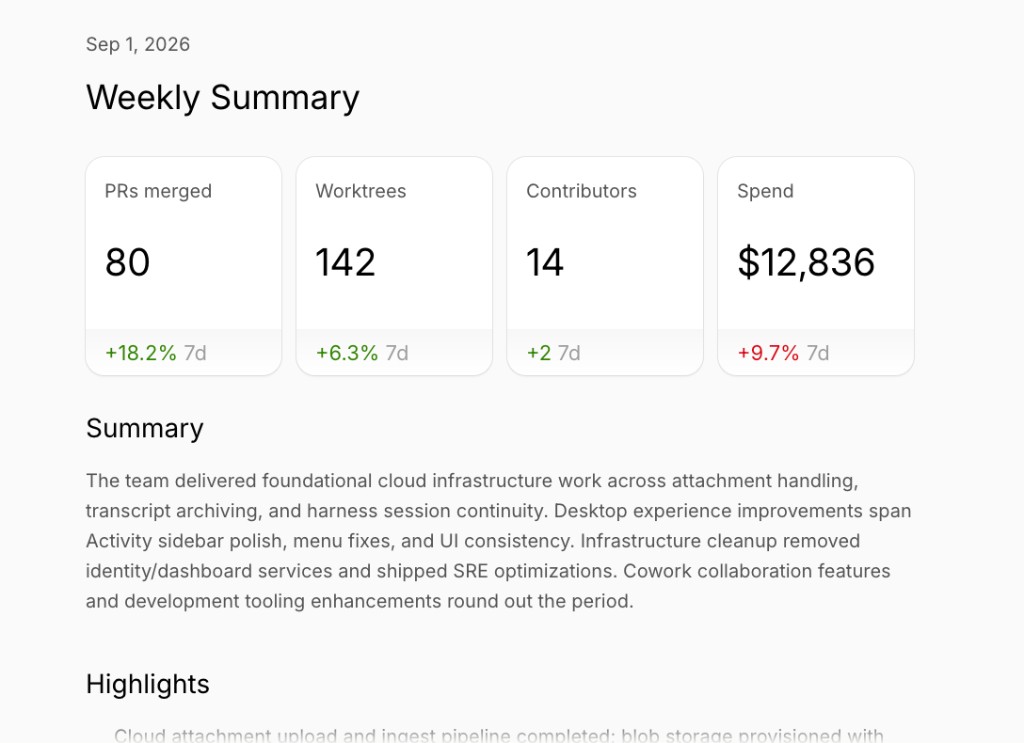
Look at how AI developer tools like Multica, UnstoppableCode, Beads, and Conductor are sold right now. Build your code factory. Scale a team of agents. Unblock your agents from anywhere, from your phone. Weekly dashboards that lead with pull requests merged, up 18% on last week. Review loops that run until the code earns a passing score.
Each of these is reasonable on its own, and some are useful. But every one of them asks something of you. Another agent is another thing to watch. A notification on your phone means work can reach you at dinner. A dashboard that counts pull requests means someone is counting. A review loop that runs until it passes still ends with you deciding whether to trust it.
Nobody designed this to wear you out. These tools get built around what agents can do, rather than what a person can take in. Agents can run all night, in parallel, without getting tired. You can't. Trust me, I've tried.
We should be honest: we're building one of these tools too. That's why we've had to think hard about this.
There's another pressure behind it. One of the recurring themes in the survey's written answers was AI driving unsustainable productivity expectations from management. A dashboard that leads with output is that pressure turned into a feature.
Attention is a budget
One idea has changed how we design: your attention is a budget. Every time a tool asks you to read, decide, review, or even glance at something, it spends from that budget. And most of us run out. 57% of developers say they're emotionally drained by the end of the workday.
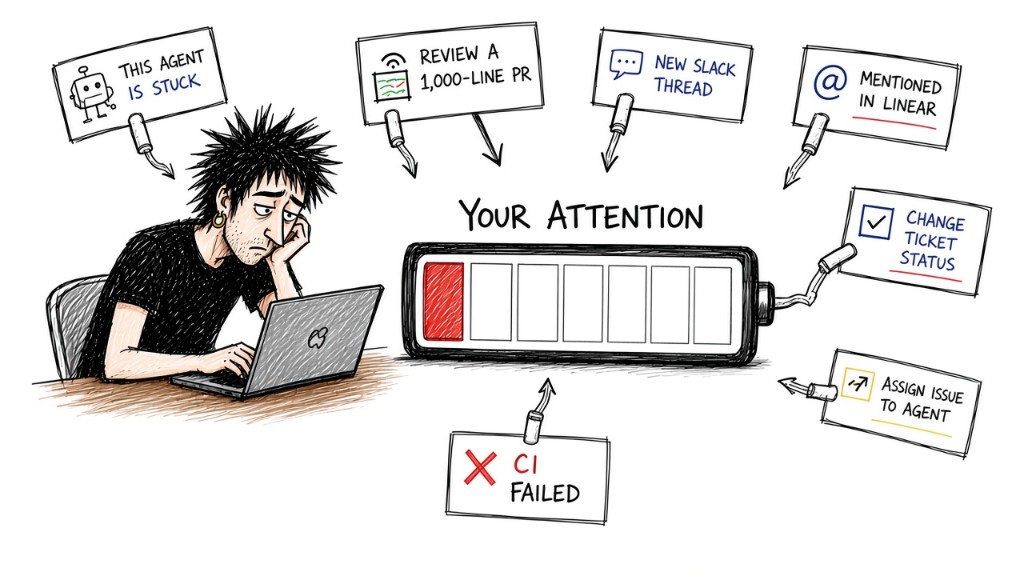
Spending it is fine. Some of the most valuable work you do is spending attention well: thinking through a plan, making a call only you can make, reading a colleague's idea carefully, deciding whether the thing you shipped actually worked.
What drains the budget is the stuff that didn't need you. Watching agents work. Answering questions an agent could have answered by reading the code. Auditing a diff line by line for the kind of mistakes machines make. Being interrupted by something that could easily have waited until the afternoon.
Cut that, and there's more left for the work that needs a person.
The best spend is each other
If attention is a budget, the best thing to spend it on is other people.
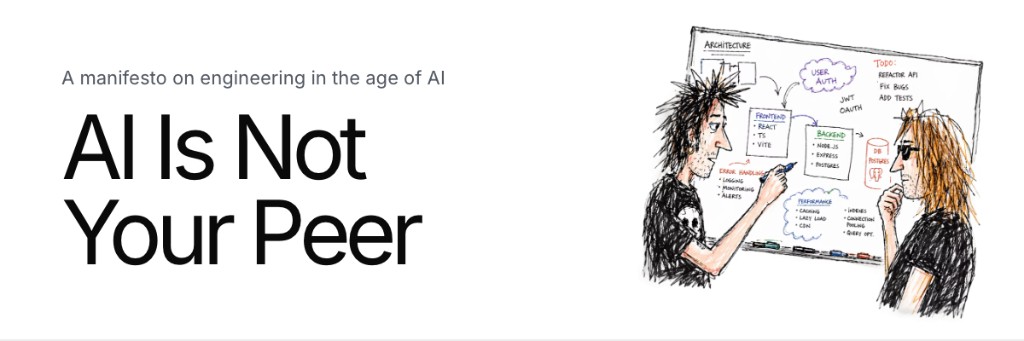
We wrote about this in our manifesto, AI Is Not Your Peer. Engineering was built by people who took the time: the senior engineer who walked you through the codebase, the stranger whose answer you found at 2am. Peer review did two jobs. It caught mistakes, and it was how we learned.
Reviewing an agent's pull request only does the first. You're auditing a machine. The agent doesn't learn from your feedback, and there's no one on the other side to talk to. Somewhere along the way, as the manifesto puts it, we just stopped asking each other.
The survey doesn't ask about this directly, but it fits what it does show. The work feels less rewarding. Half of developers have trouble focusing on tasks they used to enjoy. Only 12% would describe themselves as engaged.
You don't have to stop using agents to get this back. Split the review instead: a colleague reviews the plan, because that's where the human thinking is, and an agent checks that the code does what the plan said.
What we're designing around
Here are four principles we're building on. You don't need any particular tool to start on them.
Review the plan, not the diff. The plan is where the decisions live, so it's the part worth a person's attention. Before an agent writes any code, have a colleague read the plan.
Ask once, and only the right person. Ten questions arriving one at a time pull you out of your work ten times. Let agent questions build up and answer them at set times, rather than as they arrive.
Silence by default. When nothing needs you, a tool should say so and get out of the way. Turn off agent notifications outside working hours, and run only as many agents in parallel as you can actually follow.
Measure whether it worked, not how much was made. Pull request counts tell you how busy the agents were, not whether anything improved. In your next retro, ask "did it work?" instead of "how much did we ship?"
This is how we're building our own tool. When an agent needs a decision, its questions arrive together, sent to the person responsible for the work. An agent checks the code against your plan, and it can never mark its own mistakes as fixed; a later review has to confirm them. When nothing needs you, it tells you so.
Decide it together
The survey closes by asking us to keep talking about the impact of AI, and about "the parts of our work that give us joy and meaning, and how we can stand up for them." We agree.
None of this is settled. The tools are new, and the habits we build around them this year will shape the job for a long time. Protect your attention for the work that needs you and for the people you work with. And if you've found a way to do that, tell us how; we'd like to learn from you.
If you're interested in what we're building, sign up to the waiting list at notyourpeer.com.